Godfather Politics has an interesting article about the EPA. It is worth reading the whole thing. Here is a little quote from it.
With no real supply of cellulosic biofuel to be had, the fuel companies were unable to comply with the EISA requirements, the Environmental Protection Agency is moving forward with their plans to impose fines on the fuel companies for failing to meet the guidelines. And if the fuel companies are unable to get their hands on 8.65 million gallons of cellulosic biofuel this year to meet the requirements, they’ll face even stiffer fines.
Showing posts with label stewardship. Show all posts
Showing posts with label stewardship. Show all posts
Wednesday, January 11, 2012

Sunday, October 9, 2011
Walter Williams and Thomas Sowell
Another intelligent idea from Walter Williams:
I believe that a person who is 65 years old and has been forced into Social Security is owed something. But the question is, Who owes it to him? Congress has spent every penny of his Social Security "contribution." Young workers have no obligation to be fleeced in order to make up for the dishonesty and dereliction of Congress. The tragedy is that most seniors just want their money and couldn't care less about whom Congress takes it from.
Here's what might be a temporary fix: The federal government owns huge quantities of wasting assets -- assets that are not producing anything -- 650 million acres of land, almost 30 percent of the land area of the United States. In exchange for those who choose to opt out of Social Security and forsake any future claim, why not pay them off with 40 or so acres of land? Doing so would give us breathing room to develop a free choice method to finance retirement.
My husband and I would gladly get out of SS for 80 acres (even if it was in the middle of nowhere). You can read the rest of the article here.
Another very excellent economist is Thomas Sowell. I loved this quote from a recent article.
Depending on what criteria are used, you can have as much official poverty as you want, regardless of whether it bears any relationship to reality.
Those who believe in an expansive, nanny state government need a large number of people in "poverty" to justify their programs. They also need a large number of people dependent on government to provide the votes needed to keep the big nanny state going.
Think about this the next time you here poverty stats.
I believe that a person who is 65 years old and has been forced into Social Security is owed something. But the question is, Who owes it to him? Congress has spent every penny of his Social Security "contribution." Young workers have no obligation to be fleeced in order to make up for the dishonesty and dereliction of Congress. The tragedy is that most seniors just want their money and couldn't care less about whom Congress takes it from.
Here's what might be a temporary fix: The federal government owns huge quantities of wasting assets -- assets that are not producing anything -- 650 million acres of land, almost 30 percent of the land area of the United States. In exchange for those who choose to opt out of Social Security and forsake any future claim, why not pay them off with 40 or so acres of land? Doing so would give us breathing room to develop a free choice method to finance retirement.
My husband and I would gladly get out of SS for 80 acres (even if it was in the middle of nowhere). You can read the rest of the article here.
Another very excellent economist is Thomas Sowell. I loved this quote from a recent article.
Depending on what criteria are used, you can have as much official poverty as you want, regardless of whether it bears any relationship to reality.
Those who believe in an expansive, nanny state government need a large number of people in "poverty" to justify their programs. They also need a large number of people dependent on government to provide the votes needed to keep the big nanny state going.
Think about this the next time you here poverty stats.
Thursday, September 29, 2011
Ahh, There's the Common Sense
I love the way that Walter Williams puts our economic situation in easy-to-understand no-bull terms.
If European governments and the U.S. Congress ceased the practice of giving people what they have not earned, budgets would be more than balanced. For government to guarantee a person a right to goods and services he has not earned, it must diminish someone else's right to what he has earned, simply because governments have no resources of their very own.
To read the whole article, go here.
So many people seem to think that the federal government (or other civil governments) has money (or something of value) of its own accord. Granted, it can manufacture more at the factory right down the road from where I live (which is very interesting to tour if you ever have the chance). But all that does is devalue the money you have in your bank and your future earnings. All of the money given to various people by any form of government is taken by force from other people. A possible exception might be rentier states. In that case the money given out by the government still comes from other people, but the people are from outside the country who rent our buy something of value from the country and all the citizens get a share.
Anyway, Dr. Williams' quote reminds me of one from the Ten Commandments. "You shall not covet your neighbor's house. You shall not covet your neighbor's wife, or his manservant or maidservant, his ox or donkey, or anything that belongs to your neighbor."
If European governments and the U.S. Congress ceased the practice of giving people what they have not earned, budgets would be more than balanced. For government to guarantee a person a right to goods and services he has not earned, it must diminish someone else's right to what he has earned, simply because governments have no resources of their very own.
To read the whole article, go here.
So many people seem to think that the federal government (or other civil governments) has money (or something of value) of its own accord. Granted, it can manufacture more at the factory right down the road from where I live (which is very interesting to tour if you ever have the chance). But all that does is devalue the money you have in your bank and your future earnings. All of the money given to various people by any form of government is taken by force from other people. A possible exception might be rentier states. In that case the money given out by the government still comes from other people, but the people are from outside the country who rent our buy something of value from the country and all the citizens get a share.
Anyway, Dr. Williams' quote reminds me of one from the Ten Commandments. "You shall not covet your neighbor's house. You shall not covet your neighbor's wife, or his manservant or maidservant, his ox or donkey, or anything that belongs to your neighbor."
Friday, June 10, 2011
Examples of unanswered questions
I thought I should clarify the last few sentences of my previous post. "There is no platform to make concerns known. There is no platform for dialogue and debate. There is no platform to share new ideas gleaned from scripture. There is no fellowship in the Word only the dissemination of information and the acceptance of it by the masses."
In these sentences, I am referring to dialogue, debate, fellowship between the masses and the leaders. In a church of 5000 people with about 50 leaders (elders, ministers, etc.), I realize that they can't all sit down and listen to each persons complaint, question, or concern as a group. And I realize that on a one on one basis they are generally willing to listen to and study with individual members. Our leaders are caring, god-fearing people as far as I can tell by my limited exposure to them. The only one I have any kind of relationship with is the Missions Minister because I see him almost weekly as I'm on the missions committee.
I have been thinking/praying about what would be a viable solution to this longing for open and frank discussion. So far my best thought has been a congregational convention. I know that several denominations have conventions. Ours doesn't, but I thought that a congregational convention would be a breath of fresh air to me and would deepen the sense of body and community. I would especially enjoy an open mic session where everyone could ask questions of all the elders/ministers and everyone could hear the response and follow up with questions of their own. I think that this would increase the transparency of our church 100 fold. It would allow members with similar questions to know that they are not alone.
Here are some of the questions I would ask:
Why are we not allowed to actively promote 40 Days for Life as part of our pro-life ministry? (I help found the ministry and I am still fuzzy on the answer to this question.)
How much of our $10,000,000 auditorium renovation is repair and how much of it is upgrade? (In a financial responsibility small group study that was sponsored by the church in the run up to the fund-raising drive, this was one of the guidelines for spending in your family. For example, are we getting a new TV because ours broke or because we want a trendy upgrade?)
How will the Christian university we are starting in Africa be different than a secular university in the areas of science, economics, history, government, etc.?
In the missions committee, we often discuss the "felt need" of a people group as a springboard to a ministry that gives our missionaries an easier tie to the people. I think that one of the "felt needs" of Americans is weight loss. Are we willing to look into being of service to our community in this way?
What are other felt needs of the residents of Tarrant County and how do you see us reaching out to people who feel these needs?
Why is the biggest celebration that goes on at this building on Halloween and called "Fall Festival" instead of at Christmas or Easter? Why are the decorations at Christmas entirely secular with 6 trees and no nativity scene?
When the Wednesday night kids classes were moved to the chapel so the teachers could get their rooms decorated for Summer Spectacular (our VBS), why was Evan Almighty chosen as the movie for elementary students? Is playing a movie that doesn't uphold the Bible as accurate really a wise thing to show impressionable kids? Does this church uphold that a literal world-wide flood happened 4500 years ago? (Our Summer Spectacular theme this year is Noah.)
Why doesn't our church take a stand against evolution by hosting creation science speakers especially when the Institute for Creation Research is only a few miles away?
In a recent sermon, the new minister mentioned that it was a Christian's responsibility to fight global warming, eat organic, recycle, etc. This seems a dangerous road to be going down. Much of the green movement is more concerned about "Mother Earth" than about people especially the poor. Global warming (if it is occurring at all) is not likely caused by people. Can you please explain further what this church's view is of these issues? Would some of the leaders be willing to watch the DVD series Resisting the Green Dragon by the Cornwall Alliance and give your collective opinion in a future meeting?
What are common lies taught to our kids by the public school system and what are some ways that parents can combat them?
I am sure I would have more as the answer to these came in. Some of these questions are recent, but others I have been trying to get a solid answer on for months or years.
Thanks again for your input.
In these sentences, I am referring to dialogue, debate, fellowship between the masses and the leaders. In a church of 5000 people with about 50 leaders (elders, ministers, etc.), I realize that they can't all sit down and listen to each persons complaint, question, or concern as a group. And I realize that on a one on one basis they are generally willing to listen to and study with individual members. Our leaders are caring, god-fearing people as far as I can tell by my limited exposure to them. The only one I have any kind of relationship with is the Missions Minister because I see him almost weekly as I'm on the missions committee.
I have been thinking/praying about what would be a viable solution to this longing for open and frank discussion. So far my best thought has been a congregational convention. I know that several denominations have conventions. Ours doesn't, but I thought that a congregational convention would be a breath of fresh air to me and would deepen the sense of body and community. I would especially enjoy an open mic session where everyone could ask questions of all the elders/ministers and everyone could hear the response and follow up with questions of their own. I think that this would increase the transparency of our church 100 fold. It would allow members with similar questions to know that they are not alone.
Here are some of the questions I would ask:
Why are we not allowed to actively promote 40 Days for Life as part of our pro-life ministry? (I help found the ministry and I am still fuzzy on the answer to this question.)
How much of our $10,000,000 auditorium renovation is repair and how much of it is upgrade? (In a financial responsibility small group study that was sponsored by the church in the run up to the fund-raising drive, this was one of the guidelines for spending in your family. For example, are we getting a new TV because ours broke or because we want a trendy upgrade?)
How will the Christian university we are starting in Africa be different than a secular university in the areas of science, economics, history, government, etc.?
In the missions committee, we often discuss the "felt need" of a people group as a springboard to a ministry that gives our missionaries an easier tie to the people. I think that one of the "felt needs" of Americans is weight loss. Are we willing to look into being of service to our community in this way?
What are other felt needs of the residents of Tarrant County and how do you see us reaching out to people who feel these needs?
Why is the biggest celebration that goes on at this building on Halloween and called "Fall Festival" instead of at Christmas or Easter? Why are the decorations at Christmas entirely secular with 6 trees and no nativity scene?
When the Wednesday night kids classes were moved to the chapel so the teachers could get their rooms decorated for Summer Spectacular (our VBS), why was Evan Almighty chosen as the movie for elementary students? Is playing a movie that doesn't uphold the Bible as accurate really a wise thing to show impressionable kids? Does this church uphold that a literal world-wide flood happened 4500 years ago? (Our Summer Spectacular theme this year is Noah.)
Why doesn't our church take a stand against evolution by hosting creation science speakers especially when the Institute for Creation Research is only a few miles away?
In a recent sermon, the new minister mentioned that it was a Christian's responsibility to fight global warming, eat organic, recycle, etc. This seems a dangerous road to be going down. Much of the green movement is more concerned about "Mother Earth" than about people especially the poor. Global warming (if it is occurring at all) is not likely caused by people. Can you please explain further what this church's view is of these issues? Would some of the leaders be willing to watch the DVD series Resisting the Green Dragon by the Cornwall Alliance and give your collective opinion in a future meeting?
What are common lies taught to our kids by the public school system and what are some ways that parents can combat them?
I am sure I would have more as the answer to these came in. Some of these questions are recent, but others I have been trying to get a solid answer on for months or years.
Thanks again for your input.
Friday, October 15, 2010
Movies Worth Considering
I Want Your Money
You can find out more about this movie (in theaters now) by going to their website.
Blood Money is a documentary about the abortion industry and is now available on DVD.
The San Antonio Christian Independent Film Festival is starting October 23rd. This is the venue where people started to get excited about movies like the Widow's Might last year. Sybil Ludington is the one I am most interested in this year. Enjoy the trailer below.
You can find out more about this movie (in theaters now) by going to their website.
Blood Money is a documentary about the abortion industry and is now available on DVD.
The San Antonio Christian Independent Film Festival is starting October 23rd. This is the venue where people started to get excited about movies like the Widow's Might last year. Sybil Ludington is the one I am most interested in this year. Enjoy the trailer below.
Sybil Ludington Full Length Trailer from KICKS Ministries on Vimeo.
Saturday, October 9, 2010
Raising Kids to Do Hard Things Day One
My husband and I just got back from the Raising Kids to Do Hard Things Conference in Dallas. It was a day and a half of presentations my Gregg Harris (father of Joshua, Brett, and Alex Harris). Friday evening had two sessions.
The first one was about why God commands us to do hard things. One thing that I thought was interesting in this session was his point that God has used the curses of Adam (struggle to provide) and the curse of Eve (struggle in bearing children) to bring about the good of a godly household. He also pointed out that sin is a problem of not really believing that God is good and wise and that his ways for our lives are good (for us) and wise. He reminded us that we are here to glorify God. He went on to explain that glorifying God means putting his goodness on display.
The second session was about the seasons of life. He used Jeremiah's instructions to the Jewish exiles to show that there are for seasons of life: 1) Individual 2) Householder 3) Elder 4) City Father. He said that whatever stage you are in you should focus on that and do well at it because it prepares you for the next stage.
I really recommend signing up if Mr. Harris is doing one of these conferences in your area. The next ones are in Atlanta, DC, and Orlando. There may be more beyond that. It is definitly well worth your time.
The first one was about why God commands us to do hard things. One thing that I thought was interesting in this session was his point that God has used the curses of Adam (struggle to provide) and the curse of Eve (struggle in bearing children) to bring about the good of a godly household. He also pointed out that sin is a problem of not really believing that God is good and wise and that his ways for our lives are good (for us) and wise. He reminded us that we are here to glorify God. He went on to explain that glorifying God means putting his goodness on display.
The second session was about the seasons of life. He used Jeremiah's instructions to the Jewish exiles to show that there are for seasons of life: 1) Individual 2) Householder 3) Elder 4) City Father. He said that whatever stage you are in you should focus on that and do well at it because it prepares you for the next stage.
I really recommend signing up if Mr. Harris is doing one of these conferences in your area. The next ones are in Atlanta, DC, and Orlando. There may be more beyond that. It is definitly well worth your time.
Monday, June 21, 2010
Hay and Oil
Now this makes more sense than the stuff they've been spraying into the Gulf that turns the oil into globs.
Friday, June 4, 2010
No Where to Cut
The Heritage Foundation released a study called Federal Spending by the Numbers. My favorite (or most annoying) section is "No Where to Cut". In it they highlight some of the most obvious (to thinking people) places the government could cut if it was serious about having any kind of a balanced budget. I'll point out some, but recommend you read the whole thing.
The federal government made at least $98 billion in improper payments in 2009.
Washington spends $25 billion annually maintaining unused or vacant federal properties. (Maybe we should start selling federal property.)
Government auditors spent the past five years examining all federal programs and found that 22 percent of them—costing taxpayers a total of $123 billion annually—fail to show any positive impact on the populations they serve. (Is there any discussion about cutting these programs?)
Because of overstaffing, the U.S. Postal Service selects 1,125 employees per day to sit in empty rooms. They are not allowed to work, read, play cards, watch television, or do anything. This costs $50 million annually. (I know that $50 million is just a drop in the bucket, but this seems ludicrous beyond words.)
While we are talking about the post office. . .
A GAO audit classified nearly half of all purchases on government credit cards as improper, fraudulent, or embezzled. Examples include gambling, mortgage payments, liquor, lingerie, iPods, Xboxes, jewelry, Internet dating services, and Hawaiian vacations. In one extraordinary example, the Postal Service spent $13,500 on one dinner at a Ruth’s Chris Steakhouse, including “over 200 appetizers and over $3,000 of alcohol, including more than 40 bottles of wine costing more than $50 each and brand-name liquor such as Courvoisier, Belvedere and Johnny Walker Gold.” The 81 guests consumed an average of $167 worth of food and drink apiece.
Improper or fraudulent Medicare spending now totals $47 billion annually—12.4 percent of its budget.
Federal employees owe more than $3 billion in income taxes they failed to pay in 2008. (I wonder how many of them work for the IRS?)
Over half of all farm subsidies go to commercial farms, which report average household incomes of $200,000.
The refusal of many federal employees to fly coach costs taxpayers $146 million annually in flight upgrades. (Again a drop in the bucket, but if it is good enough for we the people, it should be good enough for our servants.)
Congress recently spent $2.4 billion on 10 new jets that the Pentagon insists it does not need and will not use.
The federal government made at least $98 billion in improper payments in 2009.
Washington spends $25 billion annually maintaining unused or vacant federal properties. (Maybe we should start selling federal property.)
Government auditors spent the past five years examining all federal programs and found that 22 percent of them—costing taxpayers a total of $123 billion annually—fail to show any positive impact on the populations they serve. (Is there any discussion about cutting these programs?)
Because of overstaffing, the U.S. Postal Service selects 1,125 employees per day to sit in empty rooms. They are not allowed to work, read, play cards, watch television, or do anything. This costs $50 million annually. (I know that $50 million is just a drop in the bucket, but this seems ludicrous beyond words.)
While we are talking about the post office. . .
A GAO audit classified nearly half of all purchases on government credit cards as improper, fraudulent, or embezzled. Examples include gambling, mortgage payments, liquor, lingerie, iPods, Xboxes, jewelry, Internet dating services, and Hawaiian vacations. In one extraordinary example, the Postal Service spent $13,500 on one dinner at a Ruth’s Chris Steakhouse, including “over 200 appetizers and over $3,000 of alcohol, including more than 40 bottles of wine costing more than $50 each and brand-name liquor such as Courvoisier, Belvedere and Johnny Walker Gold.” The 81 guests consumed an average of $167 worth of food and drink apiece.
Improper or fraudulent Medicare spending now totals $47 billion annually—12.4 percent of its budget.
Federal employees owe more than $3 billion in income taxes they failed to pay in 2008. (I wonder how many of them work for the IRS?)
Over half of all farm subsidies go to commercial farms, which report average household incomes of $200,000.
The refusal of many federal employees to fly coach costs taxpayers $146 million annually in flight upgrades. (Again a drop in the bucket, but if it is good enough for we the people, it should be good enough for our servants.)
Congress recently spent $2.4 billion on 10 new jets that the Pentagon insists it does not need and will not use.
Friday, April 30, 2010
Two Trailers Worth Watching
Today I came across two trailers that are worth looking into. The first is for an independent movie called BloodMoney. I can't embed it so you will have to actually follow a link to watch it. It is a documentary about the abortion industry from a pro-life perspective.
The second trailer is for a DVD series called Resisting the Green Dragon. Here is the blurb from the website.
 And here is the trailer:
The second trailer is for a DVD series called Resisting the Green Dragon. Here is the blurb from the website.
 And here is the trailer:
Tuesday, April 27, 2010
Crazy World
The May 2010 issue of Newsmax has an article called "Abuse, Waste, and Blunders". In it Clayton B. Reid recounts many of the idiotic things our federal government has given money for in the name of job creation and "stimulus". It is an article worth reading though it might make you a little sick. Take this one for example.
It seems like a simple enough message: If you're a drug user, use a condom. But the folks at the University of Washington in Seattle think the Real Men Are Safe project, which stresses that message, appeals only to white men. So they'll be using $448,112 in public funds to make the program "more culturally relevant" to black and Hispanic men. To accomplish this, they will convene a panel "of academic and community based-experts knowledgeable in HIV prevention in African-American and Hispanic communities" to revise materials to be more minority friendly. It creates no jobs.
This to me is sickening on so many levels. First of all, shouldn't the slogan be something like Real Men Don't Do Drugs and Wait for Marriage. Wouldn't that do the most to prevent HIV among all communities? Second, let's look at how many people this will actually "help". There are about 80,000 blacks and Hispanics in the greater Seattle area. Let's assume that 40,000 of them are male and 30,000 of those are old enough to be doing drugs and sleeping around. Let's say these people in Seattle are about on the national average for drug use so we'll say about 2,400 black or Hispanic males in the Seattle area do drugs (and sleep around). How many of these people will even see the new message and/or be aware enough at the time to make sense of it? The whole thing seems pretty ridiculous.
It seems like a simple enough message: If you're a drug user, use a condom. But the folks at the University of Washington in Seattle think the Real Men Are Safe project, which stresses that message, appeals only to white men. So they'll be using $448,112 in public funds to make the program "more culturally relevant" to black and Hispanic men. To accomplish this, they will convene a panel "of academic and community based-experts knowledgeable in HIV prevention in African-American and Hispanic communities" to revise materials to be more minority friendly. It creates no jobs.
This to me is sickening on so many levels. First of all, shouldn't the slogan be something like Real Men Don't Do Drugs and Wait for Marriage. Wouldn't that do the most to prevent HIV among all communities? Second, let's look at how many people this will actually "help". There are about 80,000 blacks and Hispanics in the greater Seattle area. Let's assume that 40,000 of them are male and 30,000 of those are old enough to be doing drugs and sleeping around. Let's say these people in Seattle are about on the national average for drug use so we'll say about 2,400 black or Hispanic males in the Seattle area do drugs (and sleep around). How many of these people will even see the new message and/or be aware enough at the time to make sense of it? The whole thing seems pretty ridiculous.
Tuesday, April 13, 2010
$200 Million Per Arrest
We so much government spending going on I don't think any of us are surprised by amazingly high price tags for virtually nothing. But I think this takes the cake. According to Rep. John Duncan from Tennesee, the $860 million budget for the air marshals program is a complete waste. Let's look at some of the facts he shared in a speech from the House floor.
1. About 10 air marshals have been arrested (about 40) for every arrest they made on our behalf (4).
2. There are 4,000 air marshals. That is 1000 per arrest.
3. And now to finish with a quote from Rep. Duncan, "In other words, we are spending approximately $200 million per arrest. Let me repeat that: we are spending approximately $200 million per arrest."
This is our money they are wasting.
Now my husband's solution to this: Allow anyone with a concealed weapons permit to carry on planes and make citizens arrests if there is "trouble" to be handed over to the authorities upon landing. The cost to citizens would be $0.
1. About 10 air marshals have been arrested (about 40) for every arrest they made on our behalf (4).
2. There are 4,000 air marshals. That is 1000 per arrest.
3. And now to finish with a quote from Rep. Duncan, "In other words, we are spending approximately $200 million per arrest. Let me repeat that: we are spending approximately $200 million per arrest."
This is our money they are wasting.
Now my husband's solution to this: Allow anyone with a concealed weapons permit to carry on planes and make citizens arrests if there is "trouble" to be handed over to the authorities upon landing. The cost to citizens would be $0.
Friday, March 19, 2010
Kay Granger Explains IRS Expansion via Health Care Bill
Rep. Kay Granger's explanation of how the IRS will expand under this health care bill is rather frightening. Here is a quote from an e-mail she sent to her constituents.
- IRS agents verify if you have “acceptable” health care coverage;
- IRS has the authority to fine you up to $2,250 or 2.5 percent of your income (whichever is greater) for failure to prove that you have purchased “minimum essential coverage;”
- IRS can confiscate your tax refund;
- IRS audits are likely to increase;
- IRS will need up to $10 billion to administer the new health care program this decade;
- IRS may need to hire as many as 16,500 additional auditors, agents and other employees to investigate and collect billions in new taxes from Americans; and
- Nearly half of all these new individual mandate taxes will be paid by Americans earning less than 300 percent of poverty ($66,150 for a family of four.)
Monday, February 22, 2010
Two Dissimilar Items of Interest
The first item I would like to bring to your attention is this article on the biblical illiteracy of the general "Christian" population especially the youth. I don't understand how people can claim to be God seeking people and not have read what he wrote. I think that part of the problem is that people don't seek truth about anything anymore. If something can't be learned without really trying, it appears that most people don't really think they should learn it. This quote from the article sums it up pretty well.
In general we spend far less time reading anything at all in this culture, much less dense and demanding books like the Bible. Not long ago I met with a student who was struggling in one of my courses. When I asked her what she thought the trouble was, she replied, in a tone suggesting ever so slightly that the fault was mine, "Reading a lot is not a part of my learning style." She went on to inform me that students today learned more by "watching videos, listening to music, and talking to one another." She spoke of the great growth she experienced in youth group (where she no doubt spent a lot of time watching videos, listening to music, and talking with people), but her ignorance of the Bible clearly betrayed the fact that the Christian formation she experienced in her faith community afforded her little to no training in the actual reading of Scripture.
The next is a video by a scientist that did experiments to see what happens to plant when exposed to ever increasing amounts of carbon dioxide. It is definitely worth the watch.
In general we spend far less time reading anything at all in this culture, much less dense and demanding books like the Bible. Not long ago I met with a student who was struggling in one of my courses. When I asked her what she thought the trouble was, she replied, in a tone suggesting ever so slightly that the fault was mine, "Reading a lot is not a part of my learning style." She went on to inform me that students today learned more by "watching videos, listening to music, and talking to one another." She spoke of the great growth she experienced in youth group (where she no doubt spent a lot of time watching videos, listening to music, and talking with people), but her ignorance of the Bible clearly betrayed the fact that the Christian formation she experienced in her faith community afforded her little to no training in the actual reading of Scripture.
The next is a video by a scientist that did experiments to see what happens to plant when exposed to ever increasing amounts of carbon dioxide. It is definitely worth the watch.
Thursday, February 18, 2010
Olympic Flowers

Normally I wouldn't care much about who designed the bouquets that the Olympic winners receive. And I personally think they are rather ugly. But since my social justice radar is on these days, I found this story interesting. Just Beginnings is the business/charity that is fulfilling the 1800 winners bouquets. The thing that makes it interesting is that Just Beginnings offers a training program for people with multiple barriers to employment. The trainees might be ex-cons or abused women. After the the training program is completed, the participants have a marketable skill. Some of them work at the Just Beginnings store. I think this is a great way to give people a hand up instead of a hand out. You can read more about it here.
Wednesday, February 17, 2010
Got Jobs?
According to an e-mail I received from Rep. Kay Granger, "And after all that spending [referring to the stimulus bill of a year ago], unemployment rates are still sky high with the economy shedding 20,000 jobs in January alone. In fact, Texas had 1.6 percent fewer jobs in December 2009 than we did in February 2009. This has only led to more Congressional calls for another stimulus package. Only this time they will call it a 'jobs bill.'"
If we allow this "jobs bill" to pass, we are fools who will get nothing but trouble for it. I love this quote that I found on Caffeinated Thoughts.
You cannot legislate the poor into freedom by legislating the wealthy out of freedom. What one person receives without working for, another person must work for without receiving. The government cannot give to anybody anything that the government does not first take from somebody else. When half of the people get the idea that they do not have to work because the other half is going to take care of them, and when the other half gets the idea that it does no good to work because somebody else is going to get what they work for, that, my dear friend, is about the end of any nation. You cannot multiply wealth by dividing it. -Dr. Adrian Rogers
If we allow this "jobs bill" to pass, we are fools who will get nothing but trouble for it. I love this quote that I found on Caffeinated Thoughts.
You cannot legislate the poor into freedom by legislating the wealthy out of freedom. What one person receives without working for, another person must work for without receiving. The government cannot give to anybody anything that the government does not first take from somebody else. When half of the people get the idea that they do not have to work because the other half is going to take care of them, and when the other half gets the idea that it does no good to work because somebody else is going to get what they work for, that, my dear friend, is about the end of any nation. You cannot multiply wealth by dividing it. -Dr. Adrian Rogers
Tuesday, February 9, 2010
Social Justice Research
In thinking about and researching my questions on social justice, I have been reading this post by Peter Greer and Phil Smith the authors of The Poor Will Be Glad. Here are some paragraphs that highlight the complexity of the subject and how our good intentions can have bad consequences.
After the genocide [in Rwanda], Jean seized an opportunity to begin a small poultry business to provide his neighborhood with eggs. He managed to scrape together funds to purchase several fowl, and his business grew. Later, a church in America “adopted” the village where Jean lived and worked. The church decided to donate clothes and supplies. They also imported eggs from a neighboring community and gave them away. Suddenly, this one village was flooded with surplus eggs. It is not difficult to imagine what happened to Jean’s business: people went first to collect the free eggs and bought Jean’s eggs only when the supply of free eggs was depleted. The market price for eggs plummeted in Jean’s village and, as a result, Jean was forced to sell his productive assets, his chickens.
The next year, after Jean had left the poultry business, the church that had supplied the free eggs turned its attention to another disaster in another part of the world. Jean’s community had no capacity to produce eggs locally and was forced to import eggs from a neighboring town. The cost of these eggs was higher than the eggs Jean had sold, so both Jean and his village were hurt economically by the good intentions of one American church.
Have you ever donated your used T-shirts to your local thrift store? Often these are bundled and shipped to Africa. This business of secondhand Western clothing, called the mivumba trade in East Africa, decimated clothing production in countries like Uganda and Zambia that previously had thriving textile industries. Several other countries, including Nigeria and Eritrea, have imposed significant tariffs on foreign imports to avoid a similar fate. It is hard to comprehend that our used T-shirts could harm local producers on another continent, yet the American church must learn to be aware of such consequences in our increasingly interconnected world.
Saturday, February 6, 2010
Social Justice Question 1
I have been thinking for some time about justice and how it applies to socioeconomic issues for some time now. I made my self a list of questions so that I could crystalize my thoughts. So far I have only answered the first one to my satisfaction.
1. What is justice? Justice is allowing people to experience the rewards or consequences (both legal and natural) of their actions regardless of their socioeconomic status. For example, if a person commits murder, they should have the legal punishment even if they are rich or famous. A natural example would be something like this: If you drink and drive, you are more likely to crash your car. This consequence happens as a natural result. An example of a just reward would be getting the prize if you fairly won the race.
Here are the rest of my questions:
2. Is this true of countries as well? What are the natural economic consequences and rewards of various political systems, religions, and corrupt practices when looking at countries and peoples as a whole?
4. What economic system(s), religion(s), etc. are prone to produce prosperous countries?
5. Mercy is negating just consequences because you empathize with the other person or find that there extenuating circumstances. For example, an abused woman might be given a reduced sentence for murdering her husband. How much mercy can be injected into a system without collapsing the system? We cannot allow all criminals to go free or to get a minimal punishment no matter how sorry we feel for them. We would be foolish to never punish our children no matter how sad it makes us. Is it true of all systems that justice must only be sprinkled with mercy?
6. How do these ideas apply to the poor especially in other countries?
1. What is justice? Justice is allowing people to experience the rewards or consequences (both legal and natural) of their actions regardless of their socioeconomic status. For example, if a person commits murder, they should have the legal punishment even if they are rich or famous. A natural example would be something like this: If you drink and drive, you are more likely to crash your car. This consequence happens as a natural result. An example of a just reward would be getting the prize if you fairly won the race.
Here are the rest of my questions:
2. Is this true of countries as well? What are the natural economic consequences and rewards of various political systems, religions, and corrupt practices when looking at countries and peoples as a whole?
4. What economic system(s), religion(s), etc. are prone to produce prosperous countries?
5. Mercy is negating just consequences because you empathize with the other person or find that there extenuating circumstances. For example, an abused woman might be given a reduced sentence for murdering her husband. How much mercy can be injected into a system without collapsing the system? We cannot allow all criminals to go free or to get a minimal punishment no matter how sorry we feel for them. We would be foolish to never punish our children no matter how sad it makes us. Is it true of all systems that justice must only be sprinkled with mercy?
6. How do these ideas apply to the poor especially in other countries?
Thursday, January 14, 2010
Climate Change
I read two interesting articles yesterday about climate change. The first was by Walter Williams. The main point of the article is the climate change/environmentalism has become a religion for many people. Here are a couple of quotes:
The very idea that mankind can make significant parametric changes to the Earth has to be the height of arrogance. How about a few questions because temperature is just one characteristic of the Earth. The Earth's orbit is another. If all 6.5 billion of us, all at once, started jumping up and down for a little while, do you think we'd change the Earth's orbit or rotation?
Over long periods of time, there is absolutely no close relationship between C02 levels and temperature. Humans contribute approximately 3.4 percent of annual C02 levels compared to 96.6 percent by nature.
I feel I should go on record here and say that I don't buy into Dr. Williams' "billions of years", but that is the topic for another post. I think that he is right in this: People cannot change any major earth system.
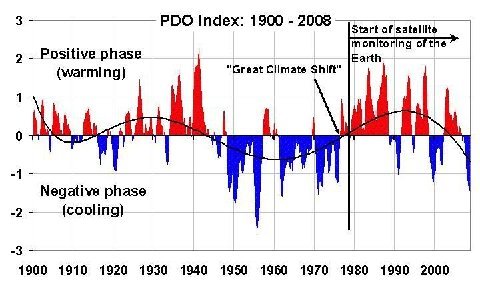
The other article was by Calvin Beisner of the Cornwall Alliance. The article was about how we may be in line for a cold trend. Check out their graph. It looks convincing to me. I wonder if we will now all be encouraged to send as much CO2 into the air as possible? Somehow I doubt it.

The very idea that mankind can make significant parametric changes to the Earth has to be the height of arrogance. How about a few questions because temperature is just one characteristic of the Earth. The Earth's orbit is another. If all 6.5 billion of us, all at once, started jumping up and down for a little while, do you think we'd change the Earth's orbit or rotation?
Over long periods of time, there is absolutely no close relationship between C02 levels and temperature. Humans contribute approximately 3.4 percent of annual C02 levels compared to 96.6 percent by nature.
I feel I should go on record here and say that I don't buy into Dr. Williams' "billions of years", but that is the topic for another post. I think that he is right in this: People cannot change any major earth system.
The other article was by Calvin Beisner of the Cornwall Alliance. The article was about how we may be in line for a cold trend. Check out their graph. It looks convincing to me. I wonder if we will now all be encouraged to send as much CO2 into the air as possible? Somehow I doubt it.
Tuesday, January 12, 2010
Nurse vs IRS
NURSE WINS! The reason this made the top of Yahoo News is because it is amazingly rare for 1 person to take on the IRS without a lawyer and win. This is one of the reasons that I think our current tax system is unjust. How can a system be truly just when "[t]he IRS's rules on deducting work-related tuition are complicated and onerous"? This same line could be said of a great deal of the ever-expanding, ever-changing tax code. Even tax preparers and accountants have difficulty keeping track of what is allowed. It has taken her about 3 years of persistent battling to get her $14,000+ deduction. She indicates that she had faced many bullies through this process saying of the judge, "But he wasn't a bully. I had met with the bullies before." Do we really want a tax system with bullying as a major component?
I think we would be much better off with the Fair Tax. Or I would even be in favor of a flat tax over the current system.
I think we would be much better off with the Fair Tax. Or I would even be in favor of a flat tax over the current system.
Friday, November 13, 2009
Fair Tax Widget
I haven't mentioned the Fair Tax in a while. I still think it is a great idea. I encourage you to try out my new widget to the right. It calculates your tax burden now versus the proposed Fair Tax.
Subscribe to:
Posts (Atom)